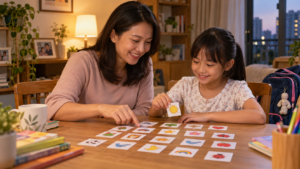
7 ways to improve your memory came to mind on 17 September 2026 after a Johor Bahru mother told me, “She remembers it with me, but she goes blank when the teacher asks.” I will call the child Mei Xin, a privacy-safe composite of Malaysian parent stories about bright children who need steadier recall habits and a little more courage.
This article was written with the assistance of an AI writing program to help organize information clearly. This image was created using an AI image creation program. Mei Xin is not a private student record; for verifiable GMA feedback, I refer parents to public reviews by Albee Kam, Cindy Sin Yi Paw, Evy Chuah, and jive ty on the memoHACK Trial Class page, and to Brunei and Keningau student sharing on the public student testimonial page. This is educational guidance, not medical advice.
7 Ways to Improve Your Memory: 7 Positive Parent Routines
Many Malaysian parents look for 7 ways to improve your memory after a full week of school, tuition, homework, co-curricular activities, and traffic. The problem is rarely that a child has learned nothing. More often, the child has no gentle routine for pulling the idea back out once the page is closed.
Genius Mind Academy’s learning approach supports focus, memory, comprehension, confidence, and learning habits. Families can also explore Genius Mind Memory Games, the 90-minute Brain Activation Class, and the memoHACK Trial Class page. I keep 7 ways to improve your memory built around ten-minute habits because small routines survive real life: dinner, younger siblings, tired parents, and the school van arriving early the next morning.
The Harvard Center guide to executive function connects learning with attention, planning, self-control, and managing information. That fits what I see when children practise. A child may know the answer, but if the recall moment feels rushed or embarrassing, the answer hides. Mei Xin’s turning point was not a fancy worksheet. It was a calmer first question.
1. Start 7 ways to improve your memory by naming the task
Before revising, ask the child to say what they are trying to remember: seven spellings, three Science steps, two moral values, or one story sequence. Naming the task sounds simple, but it lowers the fog. It tells the child where attention should land before effort begins.
In a bilingual Malaysian home, this first sentence may come out in English, Bahasa Melayu, Mandarin, Tamil, or a mix. I accept the meaning first. Later, we shape the answer into the school language. That order protects confidence while still preparing the child for class.
2. Practise look-cover-recall with pictures
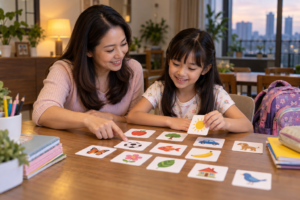
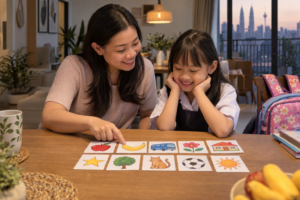
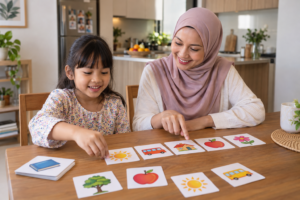
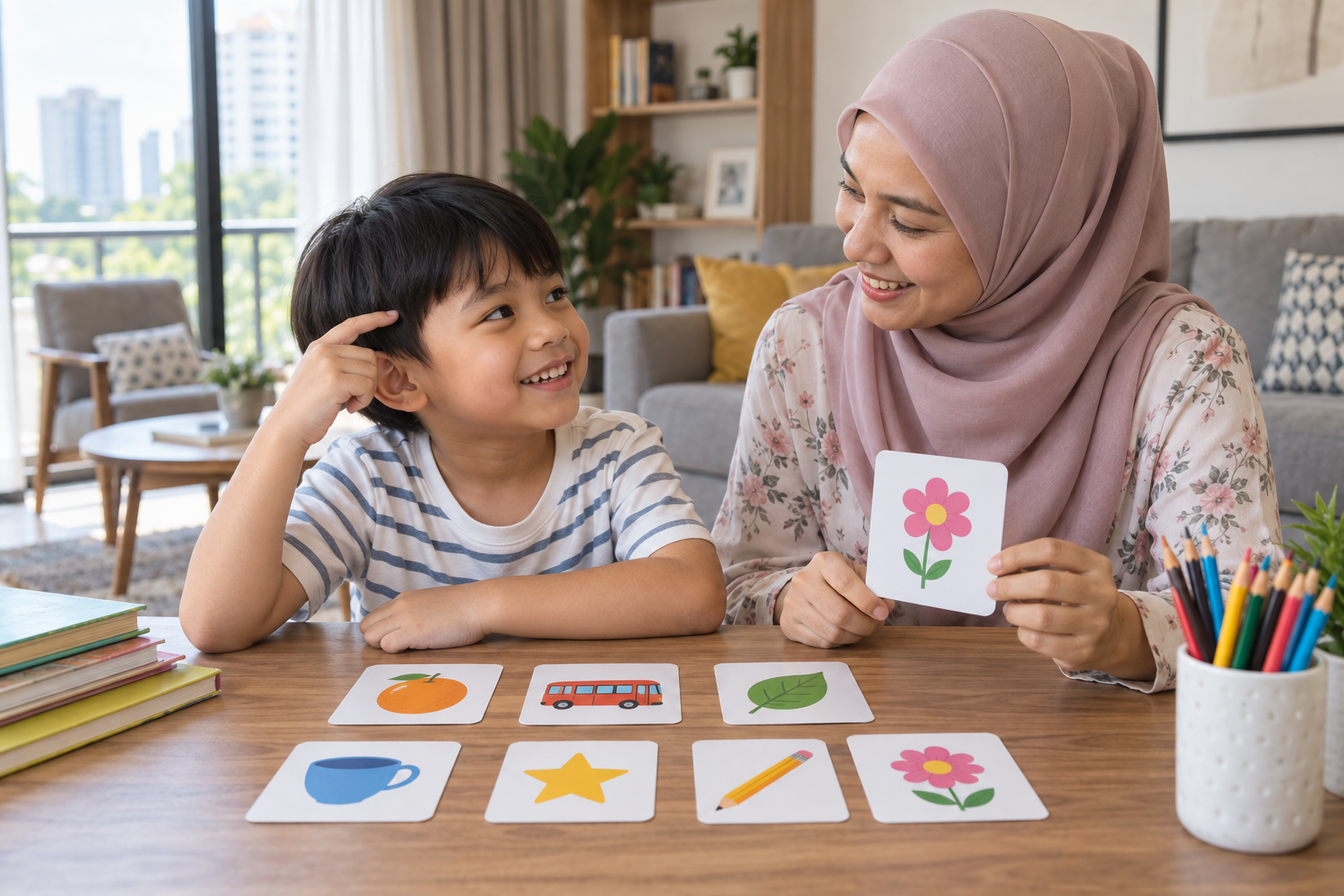
Place seven picture cards in a row. Let the child look for twenty seconds, cover the row, and ask for any three cards. Then uncover the row and celebrate what stayed. The AERO spacing and retrieval guide explains why active recall is more revealing than rereading; it shows what the child can bring back without the page doing the work.
For Mei Xin, three remembered cards were enough to change the mood. She stopped saying “I forgot everything” and started saying “I got flower, bus, and leaf.” That little sentence is why I keep 7 ways to improve your memory grounded in visible, doable practice.

3. Let the first explain-back use home language
After the recall round, ask the child to explain one card or one lesson idea to you. The first version does not need to be polished. The UNESCO multilingual education guidance reminds educators that familiar language can support understanding, and many Malaysian children think across languages before they answer in one tidy sentence.
Parents do not need to correct every grammar point immediately. First listen for meaning. Then help the child form a school-ready sentence. This makes practice feel safer for children who are already nervous about UASA practice, spelling lists, or oral answers in class.

4. Put a movement pause between rounds
The fourth habit is a short reset: stand, stretch, touch the next card, and sit down again. The WHO physical activity fact sheet notes that physical activity supports health, and a small movement break can help a tired child return to the table without a scolding session.
When parents ask for 7 ways to improve your memory, I remind them that attention is part of memory. A child who has sat through school, transport, homework, and tuition may need the body to wake up before the mind can retrieve. Keep the pause short so it supports study instead of replacing it.
5. Turn a difficult idea into a familiar scene
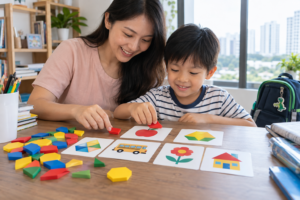
The fifth habit is association. If Mei Xin needs to remember a story sequence, we might connect each event to a picture card: house, bus, school gate, flower, pencil, book, home. The sequence becomes something she can walk through in her imagination before she writes.
Parents can use local details here. A child in Subang may remember the school van. A child in Penang may remember the morning market. A child in Kota Kinabalu may remember a weekend beach walk. Familiar scenes give recall a hook.
6. Review before sleep, not after a battle
The sixth habit is spaced review. Use the same seven cards today, tomorrow, and before the weekend. The KPM academic calendar page helps parents see learning as a rhythm across weeks, and the American Academy of Pediatrics sleep guidance explains why enough sleep supports school performance, behavior, and memory. Late-night pressure may feel productive, but many children remember better when practice is calmer and earlier.
I like families to stop while the child still has one more try left. Ending calmly is not laziness; it makes tomorrow’s practice easier to begin. That is why 7 ways to improve your memory should feel steady, not dramatic.
7. Let confidence be part of the method
The seventh habit is confidence. Ask, “Which part felt easier today?” instead of only “How many did you get?” Mei Xin’s answer might be “I remembered the bus because I made a story.” That answer tells the parent which strategy to repeat.
If 7 ways to improve your memory brought you here, try naming the task, look-cover-recall, home-language explain-back, movement, familiar scenes, spaced review, and one confidence question for three school nights. The Harvard activities guide for executive function skills has more age-appropriate executive function ideas, and parents who want guided support can contact Genius Mind Academy through the contact page.