
activities for concentration and memory became this article after a Petaling Jaya father described his Standard 3 son, whom I will call Aaron, sitting bravely with homework but drifting away after two lines. Aaron is a privacy-safe composite of Malaysian parent conversations I hear around school pressure, bilingual homework, and children who know more than they can recall on demand.
This article was written with the assistance of an AI writing program to help organize information clearly. This image was created using an AI image creation program. For verifiable GMA feedback, I point parents to the public parent reviews and public student testimonials; this story is educational guidance, not medical advice.
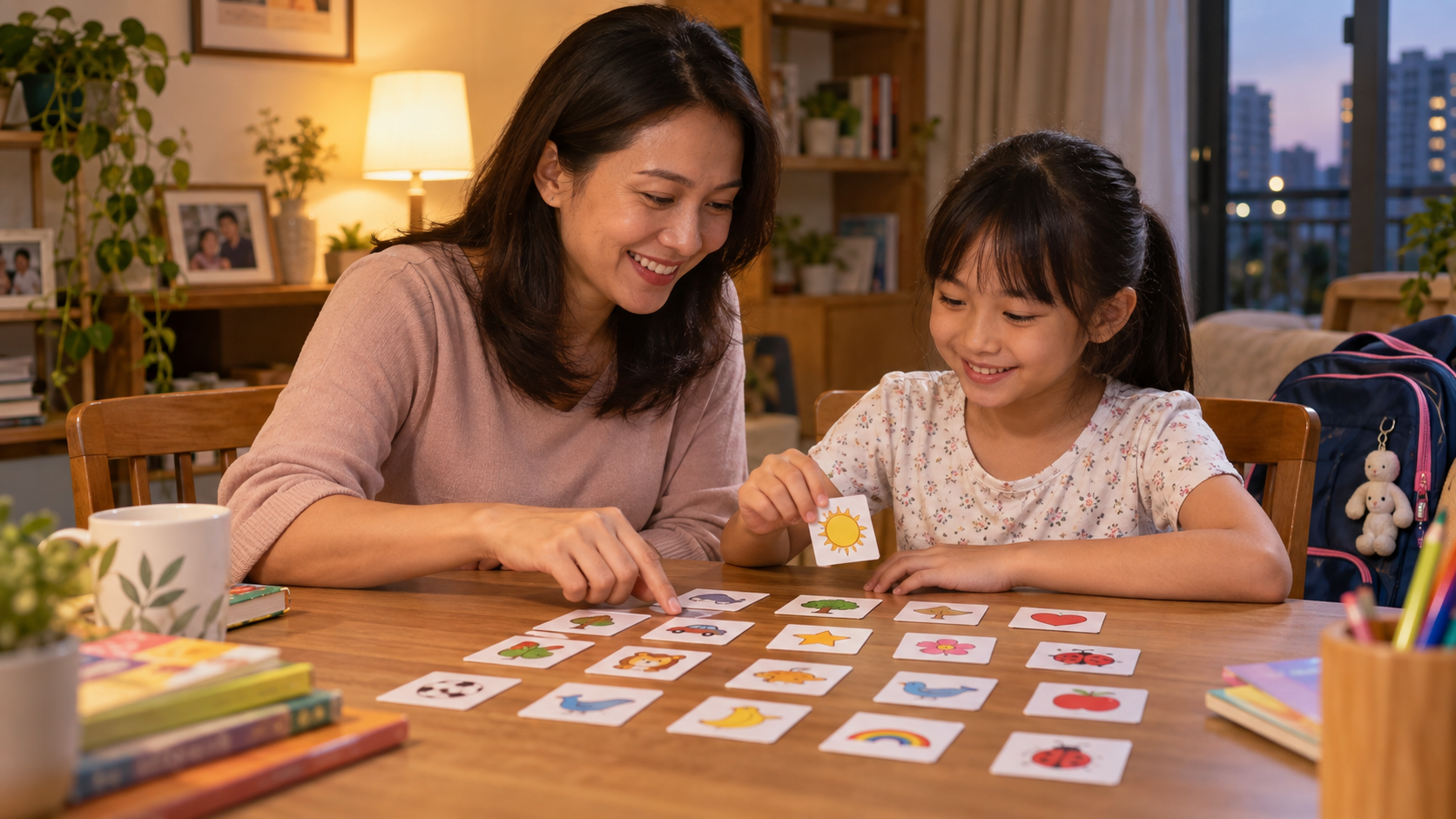
Activities for Concentration and Memory: 9 Warm School Wins
Many Malaysian parents search for activities for concentration and memory because the school day is crowded: Bahasa Melayu spelling, English comprehension, Mandarin or Tamil practice, agama work, tuition traffic, co-curricular activities, UASA preparation, PBD tasks, and older siblings talking about SPM. Parents who grew up with UPSR and PT3 sometimes still use those names as shorthand for exam stress, even as today’s classroom language has changed.
Genius Mind Academy supports focus, memory, comprehension, confidence, and learning habits. Families who want guided practice can explore GMA memory games, the brain activation class, and the MemoHack trial class. I keep activities for concentration and memory short because tired parents need routines that survive dinner, school bags, and bedtime.
The Harvard Center on the Developing Child guide to executive function explains executive function as skills that help children focus attention, manage information, and plan action. That matches what I see during practice: memory improves when attention has somewhere simple to land first.
1. Start activities for concentration and memory with seven picture cards
Put seven picture cards on the table. Let the child look for twenty seconds, cover the cards, and ask for any three pictures. With Aaron, the goal was not a perfect score. The goal was to feel one clean success before homework began.
Parents often want to correct every missing detail immediately. I prefer, “Which card stayed in your mind?” before “Which one did you forget?” The retrieval and spacing explainer is useful because it separates active recall from rereading. The child has to bring the answer back without leaning on the page.

2. Sort before memorising
Ask the child to sort cards into groups: food, transport, nature, animals, and objects. Then ask for one group at a time. This turns a messy table into a pattern the child can hold. It also builds concentration because the child must decide where each picture belongs.
This is one of my favourite activities for concentration and memory because it feels like play but still trains attention. Apple and banana become food; bus and car become transport; tree and flower become nature. Later, the same grouping habit helps with Science steps, BM isi penting, and story events.
3. Use a whisper round
After sorting, ask the child to whisper the cards in order. Whispering slows the body without making the activity feel like punishment. Some children who shout guesses at first begin to listen to themselves when the voice becomes smaller.
In Aaron’s case, the whisper round helped him notice the middle card instead of only the first and last card. That tiny observation mattered. Activities for concentration and memory work best when the parent can see one specific thing getting steadier.
4. Add a bilingual explain-back
Ask the child to explain the card story in the language that feels easiest first. It may be English, Bahasa Melayu, Mandarin, Tamil, or a mix. The UNESCO language and education note reminds educators that familiar languages can support understanding, so I listen for meaning before shaping a school-ready sentence.
For Malaysian families, this reduces shame. A child may understand a Science idea but need a bridge before answering in English. The explain-back gives that bridge.

5. Build a one-minute movement reset
Stand up, stretch, touch the next card, and sit down again. The WHO physical activity fact sheet explains the wider health value of physical activity, and in a learning room a tiny movement reset often brings attention back without scolding.
When parents ask whether activities for concentration and memory should be serious, I usually say they should be repeatable. A one-minute reset protects the mood and keeps the next recall round possible.
6. Turn one school fact into a picture
If the child must remember evaporation, connect it to wet shoes drying outside the apartment balcony. If the child must remember a moral value, connect it to returning a borrowed pencil. The picture does not need to be funny. It needs to be familiar enough to call back.
Local detail helps. A Klang Valley child may remember the LRT. A Johor Bahru child may remember a causeway trip. A Penang child may remember breakfast before school. Memory becomes stronger when the example belongs to the child’s real life.
7. Review the same cards across three nights
Use the same cards today, tomorrow, and before the weekend. The KPM academic calendar helps families see learning as a rhythm across weeks, and the HealthyChildren sleep guide is worth reading because sleep connects closely with school performance, behaviour, and memory.
I would rather a child practise ten calm minutes across three nights than fight through one exhausted hour. Activities for concentration and memory should lower pressure, not create another battle.
8. Let the child choose one card
After the adult chooses several cards, let the child add one. This gives ownership. Aaron picked a football card, and suddenly the sequence had energy. The adult still guides the method, but the child gets a small voice inside the task.
This is also a useful confidence check. If a child avoids every card, the task may be too hard. If the child adds one eagerly, you have found a level that feels safe enough to repeat.
9. End with a named win
Finish by saying the exact progress you saw: “You remembered bus, tree, and apple without looking,” or “You stayed with the cards for five minutes.” Specific feedback gives the child a memory of success, not just a score.
If activities for concentration and memory brought you here, start with seven cards, sorting, whisper recall, bilingual explain-back, movement, personal pictures, spaced review, child choice, and one named win. The Harvard activity guide has more age-appropriate practice ideas, and parents who want guided support can reach GMA through the contact page.






