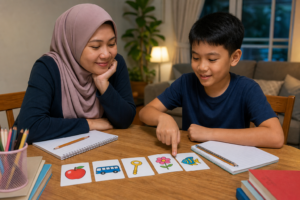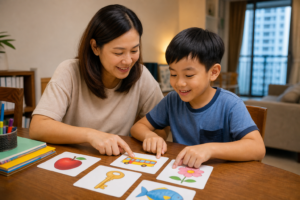
cognitive exercises for memory are not magic tricks in my coaching notes. On 1 September 2026, I wrote about a privacy-safe composite I call Arif, a Standard 5 child from Shah Alam who could remember every futsal position but lost the order of a Science process after dinner. The mistake was mine first: I had made the session too verbal.
This article was written with the assistance of an AI writing program to help organize information clearly. This image was created using an AI image creation program. Arif is not a private student file; the verifiable Genius Mind Academy feedback I can point parents to includes May Lee, Mr. Chow, and Christina on the public parent testimonial page, plus Brunei and Keningau student sharing on the public student testimonial page. I am sharing learning habits, not medical advice, diagnosis, or promised marks.

Cognitive Exercises for Memory: 7 Gentle Ways to Help Kids
When parents ask for cognitive exercises for memory, I first look at the child’s attention pathway. Can the child see the information, say it, connect it to meaning, and bring it back without panic? The Harvard Center guide to executive function gives a useful frame because executive function includes focusing attention, holding information in mind, switching tasks, and planning the next step.
Malaysian children often study in a layered language world: Malay at school, English in tuition, Mandarin or Tamil with family, and exam vocabulary around UASA, PBD, and SPM. Parents still mention UPSR and PT3 because those words shaped their own school memories. The KPM academic calendar page is a practical reminder that study routines must fit real school weeks, not perfect timetables. Genius Mind Academy’s learning approach supports focus, memory, comprehension, confidence, and learning habits.
Families who want guided structure can explore Genius Mind Memory Games, the 90-minute Brain Activation Class, and the memoHACK Trial Class page. At home, I still begin with something smaller than a worksheet: one short sequence the child can actually finish.
1. Start cognitive exercises for memory with five picture cards
I keep cognitive exercises for memory visible at the start. I placed apple, bus, cat, tree, and clock cards on the table, gave Arif twenty seconds, then covered them. He remembered three. His mother reached for the missing two, but I asked her to name the three he held first. That changed correction into coaching.
2. Turn the cards into one silly route
A route gives memory something to walk along. The bus picked up the cat, drove past a tree, and stopped under a clock for an apple snack. It sounded childish, but Arif’s shoulders dropped because he was no longer holding five loose items. He was holding a story with order.

3. Close the page earlier than feels comfortable
The Retrieval Practice guide explains why pulling learning back from memory is different from rereading. After four lines of BM or Science, I close the page and ask for two remembered ideas. If only one appears, I give a clue. Retrieval shows the parent what is actually available when the book is gone.
4. Let home language protect meaning
The UNESCO multilingual education guidance matters in Malaysia because children often understand an idea before they can express it in the expected school language. Arif explained a Science step in Malay-English first, then we shaped the school sentence. I do not rush this bridge. Meaning first usually gives the written answer a stronger base.

5. Draw or point before asking for full sentences
The Harvard activities guide for executive function skills suggests playful practice for attention and working memory across childhood. In our session, pointing to card order came before full sentences. A parent can ask, “Show me the first step,” then “Tell me why it comes first.” The child gets two chances to succeed before language becomes the main demand.
6. Use movement as a short attention reset
The WHO physical activity fact sheet notes that physical activity supports health and well-being. During revision, movement can stay modest: stand, touch the first card, say the cue, sit, and recall. I use this when a child is restless, not as a grand promise. The movement gives attention a job for thirty seconds.
7. End with one parent note
The Education Endowment Foundation metacognition summary describes learners planning, monitoring, and evaluating their own learning, while the CDC sleep guidance connects sleep with attention and memory. I ask parents to end with one note: “remembered three cards,” “used Malay first,” or “needed one clue.” That note helps tomorrow’s routine begin with evidence instead of frustration.
If cognitive exercises for memory brought you here, try one week of five picture cards, one story route, one closed-page recall, and one parent note. Parents who want guided help can contact Genius Mind Academy through the contact page. The aim is not a perfect child at 9:30 pm. The aim is a repeatable habit that still feels kind on a Malaysian school night.