Memory exercises can help children practise focus, recall, sequencing, and confidence in a way that feels positive instead of pressured. For many parents in Malaysia, the challenge is not only getting a child to study, but helping the child remember what was learned and use it calmly in schoolwork.

Memohack is an unconventional brain training program using the 565 formula: five sensory activations—(1) Visual, (2) Auditory, (3) Touch, (4) Smell, and (5) Taste; six balancing areas—[1] Focus, [2] Concentration, [3] Attention, [4] Relaxation, [5] Comprehension, and [6] Self-regulation; and five enhancements—[1] Brain Speed, [2] Brain Energy, [3] Brain Connectivity, [4] Brain Stamina, and [5] Neurogenesis. These are educational skills, not medical treatment. The aim is to give children practical habits that make learning clearer and more enjoyable.
Memory Exercises That Build Focus First
Good memory starts with attention. Before using memory exercises, clear the table, keep only the needed materials nearby, and give one short instruction at a time. A child who looks, listens, and slows down is more ready to store information.
GMA’s Brain Activation Class supports this foundation by helping children prepare their attention and learning readiness through guided activities.
1. Sequence Picture Cards

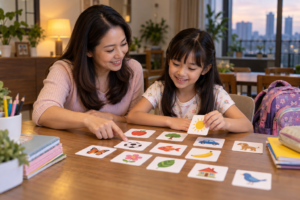
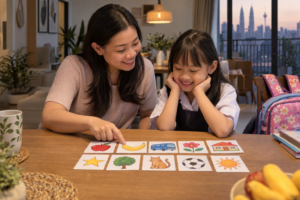
Place three to six picture cards in a row. Let your child study the order, cover the cards, then ask your child to rebuild the sequence. Younger children can start with three cards. Older children can explain the story behind the order.
This is one of the easiest memory exercises to use at home because it trains observation, order, and recall. It also supports school tasks such as following math steps, retelling a story, and remembering instructions.
2. Turn Lessons Into Pictures
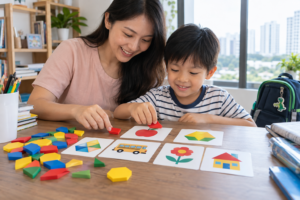
Children often remember better when they can see an idea. Ask your child to draw a quick symbol, arrange objects, or imagine a small scene related to the lesson. The drawing does not need to be neat. It only needs to make sense to the child.
This approach connects well with GMA’s Memohack Online Class, where children learn ways to organize and connect information instead of repeating harder without a plan.
3. Practise Active Recall
After reading a page, close the book and ask, “What do you remember?” Your child can say the answer, draw a simple map, arrange cards, or teach the idea back to you. This strengthens retrieval because the child has to bring the information back from memory.
Active recall should feel safe. If your child forgets, reduce the number of items and try again. Memory exercises work best when mistakes are treated as clues for the next review, not as a reason to scold.
4. Add Movement Patterns

Some children focus better when learning includes movement. Place colored mats or paper circles on the floor and create a short step pattern. Let your child watch, repeat, and slowly extend the pattern.
The CDC guidance on physical activity for children explains that regular activity supports healthy development. Movement is not a shortcut for learning, but it can make memory exercises more engaging and balanced.
5. Use Spaced Review
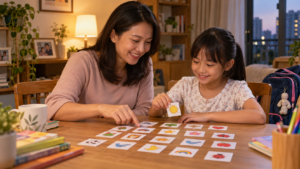
Instead of revising one topic for a long time, review briefly today, tomorrow, and again later in the week. This gives the brain repeated chances to strengthen what was learned. A small review box with cards can make this routine simple.
Cards that are remembered move to the back. Cards that are forgotten stay near the front for another short practice. This keeps review calm and manageable.
6. Build a Home Recall Map

A recall map helps children connect ideas before remembering details. Put one main idea in the middle of a page, then add small branches for examples, steps, or pictures. After a few minutes, cover the page and ask your child to rebuild it from memory.
Harvard’s Center on the Developing Child explains that executive function skills help children manage attention, information, and goals. Parent-friendly routines can support these skills through repeated practice.
7. Keep Confidence Part of the Routine
A child who feels judged may avoid trying. A child who feels supported is more willing to practise. Keep memory exercises short, praise effort, and celebrate small improvements such as remembering one extra card or explaining one step more clearly.
If your child needs guided support, explore the Memohack trial class. With steady practice, children can build stronger recall, better study habits, and more confidence in learning.