Improve memory and focus is a realistic learning goal when children practise the right habits in small, consistent steps. For many parents in Malaysia, the concern is not only that a child forgets. It is also that the child loses attention before the lesson is fully understood.

Memohack is an unconventional brain training program using the 565 formula: five sensory activations—(1) Visual, (2) Auditory, (3) Touch, (4) Smell, and (5) Taste; six balancing areas—[1] Focus, [2] Concentration, [3] Attention, [4] Relaxation, [5] Comprehension, and [6] Self-regulation; and five enhancements—[1] Brain Speed, [2] Brain Energy, [3] Brain Connectivity, [4] Brain Stamina, and [5] Neurogenesis. These are educational routines and learning strategies. They are not medical treatment, cure claims, or supplement-style promises.
Improve Memory and Focus With a Clear Start
To improve memory and focus, begin with the study environment. Keep the table simple, remove extra screens, and place only the current materials in front of the child. A short start routine can help: sit comfortably, look at the task, listen to one instruction, and repeat the first step aloud.
This foundation is part of the reason parents explore GMA’s Brain Activation Class. When children become more ready to attend, recall activities feel more manageable.
1. Use Pattern Sorting

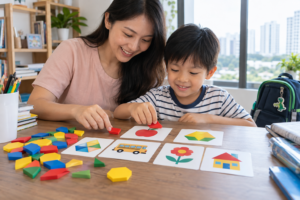
Give your child colored tokens, blocks, or picture cards. Create a short pattern and ask your child to copy it. Then cover the original and ask them to rebuild it from memory. You can increase the challenge slowly by adding one item at a time.
A child can improve memory and focus through this kind of activity because they must observe carefully, hold the sequence in mind, and check their own work. It trains attention and recall together.
2. Break Lessons Into Small Steps
Long instructions are easy to lose. Break homework into small steps and ask your child to complete one step before hearing the next. For example, read the question, circle the key information, solve the first part, then check the answer.
These routines help because they reduce overload. The child does not need to hold everything at once, so there is more mental space for understanding.
3. Practise Active Recall
After a short lesson, close the book and ask, “What do you remember?” Your child can answer aloud, draw a quick map, arrange cards, or teach the idea back. Active recall helps parents see what is clear and what needs another explanation.
GMA’s Memohack Online Class helps children use strategies such as visualization, association, and retrieval practice. These methods make study more active and less dependent on last-minute cramming.
4. Add Calm Learning Breaks

Children cannot focus well forever. Use a short learning break before attention drops too far. Stretch, breathe, walk to get water, or do a quick movement pattern. Then return to the table with one clear next task.
The CDC child activity overview notes that physical activity is part of healthy development. For learning, short movement can refresh readiness before children return to focus.
Improve Memory and Focus With Short Review

To improve memory and focus across the week, use brief spaced review. Instead of revising one topic for a long time, review for a few minutes today, tomorrow, and again later. A small card box makes this easy and visible for children.
Sleep also matters. The CDC sleep overview explains that sleep supports attention and memory. A balanced learning routine includes study, breaks, movement, and rest.
6. Keep Emotion Safe
A worried child may avoid trying, even when the task is possible. Correct gently, praise effort, and reduce the challenge when needed. Confidence is part of the learning system because children need repeated attempts to build recall.
If your child often forgets instructions, loses focus, or feels discouraged by revision, the Memohack trial class can help you explore a more structured path. With steady practice, children can improve memory and focus while building calmer study habits.