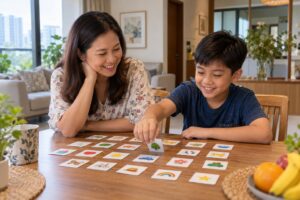
ways to help memory loss was the phrase I wrote in my 28 August 2026 planning note after a Petaling Jaya mother described a familiar scene: her child could retell a cartoon episode in detail, then forget the second homework instruction. I am using a privacy-safe composite I call Aiman, a Standard 4 child who loses order when BM comprehension, English spelling, and maths corrections all arrive on one school night.
This article was written with the assistance of an AI writing program to help organize information clearly. This image was created using an AI image creation program. Aiman is not a private student record; the real public Genius Mind Academy feedback I can point to includes May Lee, Mr. Chow, and Christina on the public parent testimonial page, plus Brunei and Keningau student sharing on the public student testimonial page. I am writing about learning habits, not medical advice.

Ways to Help Memory Loss: 7 Positive Recall Habits
When parents ask for ways to help memory loss, I first slow down the language. In many homes, “memory loss” means the child is tired, overloaded, or unsure how to hold instructions long enough to begin. The Harvard Center guide to executive function explains working memory as part of executive function, the group of skills children use for attention, planning, and self-control.
The Malaysian context matters. Parents still say UPSR and PT3 when they talk about pressure, while older siblings face SPM and younger children hear more about PBD and UASA. The Malaysia government secondary-school information reminds us how school expectations keep changing, but the dinner-table worry stays personal. Genius Mind Academy’s learning approach focuses on focus, memory, comprehension, confidence, and learning habits, so the aim is not to frighten a child with labels.
Families who want structured practice can explore Genius Mind Memory Games, the 90-minute Brain Activation Class, and the memoHACK Trial Class page. At home, I prefer one calm routine that a parent can repeat even after traffic, tuition, and a long workday.
1. Start ways to help memory loss with a calmer body
The first ways to help memory loss are ordinary: water, food, movement, and a short pause. Aiman’s mother used to open the homework book the moment they reached home. When she gave him five quiet minutes and a snack first, the argument reduced before any memory exercise began. That small change did not solve everything, but it made practice possible.
2. Use five picture cards, not five warnings
Put five picture cards on the table: banana, bus, key, flower, fish. Let the child look for ten seconds, cover them, and rebuild the order. If three return, name the three first. Children hear enough correction at school; memory grows better when success is visible.

3. Ask the child to echo only the next two steps
A long instruction can disappear before a child starts. I like two-step echoing: “Read the question, underline the key word.” After that, add “answer the first part.” This is one of the ways to help memory loss at the homework table because it turns a floating instruction into a spoken plan.
4. Practise recall after reading, not only rereading
The Retrieval Practice guide explains why bringing information back strengthens learning. After a short science or BM paragraph, close the book and ask for two remembered points. If the child remembers one, give a clue instead of a lecture. Aiman’s mother found that his confidence improved when she praised the first accurate point before asking for the second.

5. Let home language support understanding
The UNESCO multilingual education guidance is relevant in Malaysian homes where a child may think in Malay, Mandarin, Tamil, Cantonese, or English at different moments. If the child understands a topic in the home language first, let that meaning settle, then help shape the school-language answer. Memory is easier when comprehension is real.
6. Use movement for the child who cannot sit still
The WHO physical activity fact sheet connects movement with health and well-being. For study, movement can be tiny: step to a card, say it, step back, recall the order. Aiman liked this more than sitting still because the energy had a job. Parents can use movement without turning study time into chaos.
7. Stop with one remembered win
The CDC sleep guidance links sleep with attention and memory. I have made the mistake of pushing one more round when a child was already done. The page looked complete, but the next session began with resistance. Now I would rather stop with one remembered win and protect the next day.
If ways to help memory loss brought you here, start with five picture cards and two-step echoing for one week. Parents who want a guided plan can contact Genius Mind Academy through the contact page. Keep the practice respectful, short, and clear enough that your child still wants to try tomorrow.