mind exercises for memory became real to me again on 10 September 2026, after a Klang Valley mother described her Standard 4 son, Jun Wei, forgetting spelling order right after tuition. He was not lazy. He was tired, switching between English, BM, and Mandarin, and trying to hold too many instructions at once.
This article was written with the assistance of an AI writing program to help organize information clearly. This image was created using an AI image creation program. Jun Wei is a privacy-safe composite, not a private student record; for verifiable GMA feedback, I can point to public parent reviews by Albee Kam, Cindy Sin Yi Paw, Evy Chuah, and jive ty on the memoHACK Trial Class page, plus May Lee, Mr. Chow, and Christina on the parent testimonial videos. I am sharing classroom observations, not promised exam marks.

Mind Exercises for Memory: 7 Gentle Routines for Malaysian Kids
Parents often ask me for mind exercises for memory because the school week feels full. Children move from school to tuition, agama class, sports, music, homework, and family dinner. The KPM academic calendar page is a useful reminder that learning has a rhythm, so memory practice should be small before assessment weeks feel urgent.
Genius Mind Academy’s learning approach supports focus, memory, comprehension, confidence, and learning habits. Families who want guided practice can explore Genius Mind Memory Games, the 90-minute Brain Activation Class, and the memoHACK Trial Class page. At my table, the first aim is simple: make recall visible enough that the child can notice progress.
The Harvard Center guide to executive function describes executive function as skills that help us plan, focus attention, switch tasks, and manage information. That is why a short memory game can be more useful than another long worksheet when a child is already tired.
1. Begin mind exercises for memory with six picture cards
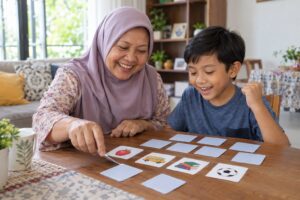
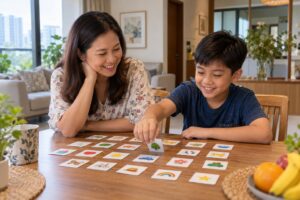
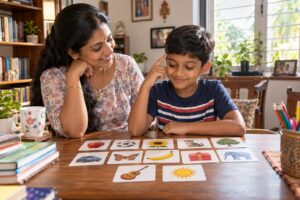
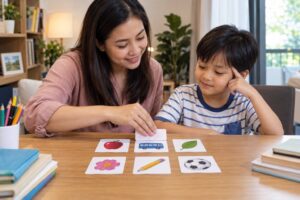
I placed apple, bus, tree, clock, umbrella, and star cards in a row. Jun Wei looked for twenty seconds, then I covered the cards. He remembered apple, bus, and tree, then stopped. I asked his mother to praise the three he held before we rebuilt the missing cards.
2. Let the child name the order, not just the object
Many children know the object but lose the sequence. We asked, “What came after bus?” That tiny question made the exercise about order, not speed. In Malaysian school work, this matters for ejaan, Science steps, karangan points, and even SPM revision later.

3. Use retrieval before rereading
The Retrieval Practice guide explains why pulling information from memory is different from only rereading. After Jun Wei read a short Science paragraph, I closed the page and asked for two ideas. He gave one idea, used the picture row, and found the second without copying everything again.
4. Give bilingual explain-back room
The UNESCO multilingual education guidance notes the value of learning through languages children understand. At home, Jun Wei explained in a Malay-English mix first. Once the idea was clear, we shaped the cleaner English sentence. For many Malaysian children, mixed language is not failure; it is a bridge to meaning.

5. Add movement only when it has a memory job
Movement can help a restless child return to attention, but I keep it structured. Step to the star, say the clue, step to the bus, say what came before it, then return to the table. The WHO physical activity fact sheet reminds families that movement supports health, and in study time it can also make attention easier to restart.
6. Ask which clue helped most
The Education Endowment Foundation metacognition summary describes pupils learning to plan, monitor, and evaluate their learning. I asked Jun Wei whether picture, position, or story helped him remember. He chose position. His mother now had a practical clue to reuse during spelling and BM review.
7. Stop before the child feels defeated
The last of my mind exercises for memory is knowing when to stop. After three good rounds, I ended the practice even though his mother wanted one more. Children remember confidence too. A short success is more useful than a long session that ends with tears.
If mind exercises for memory brought you here, try one calm routine tonight: six picture cards, one cover, one recall, one explain-back, and one question about which clue helped. The Harvard activities guide for executive function skills gives families more age-appropriate executive function ideas. Parents who want guided support can contact Genius Mind Academy through the contact page.