improve your memory and brain function was the phrase I wrote in my 19 August 2026 planning note after a mother in Petaling Jaya asked why her son could remember every football highlight but forgot Science terms after dinner. I am using an anonymized composite I call Haris, a Standard 5 child who speaks Malay with his grandparents, English at tuition, and enough Mandarin to feel the pressure of switching languages. The public feedback I can verify comes from Genius Mind Academy pages.
This article was written with the assistance of an AI writing program to help organize information clearly. This image was created using an AI image creation program. The composite protects privacy; the public names I can point parents to are May Lee, Mr. Chow, and Christina on the public parent testimonial page, plus Brunei and Keningau students on the public student testimonial page. I am not inventing private scores or outcomes.

Improve Your Memory and Brain Function: 7 Warm Routines for Kids
When Malaysian parents ask how to improve your memory and brain function, they usually want something kinder than another lecture. They want a child to remember spelling, karangan points, Science vocabulary, or the steps in a maths method without ending the night in tears. The Harvard Center guide to executive function explains executive function as skills used for planning, attention, and managing information, while the Retrieval Practice guide explains why pulling learning back to mind is useful.
My early mistake was assuming the child needed more notes. Haris’s composite mother had already bought workbooks, set phone alarms, and reduced screen time. What changed the conversation was watching when memory failed: not during play, but when the child was tired, hungry, switching languages, and afraid of giving a wrong answer.
At Genius Mind Academy, the practical focus is memory, focus, comprehension, confidence, and learning habits. This is not medical advice and it is not a promise of marks. It is a parent-friendly way to make recall visible, repeatable, and less frightening for a child who already feels judged by school-night mistakes.
1. Start improve your memory and brain function with five picture cards
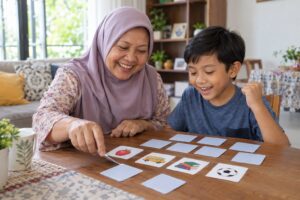
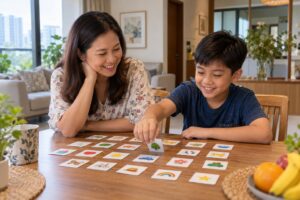
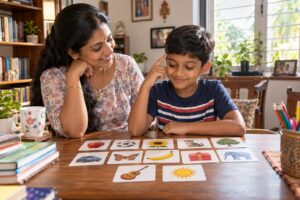
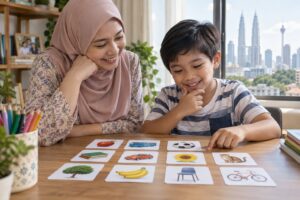
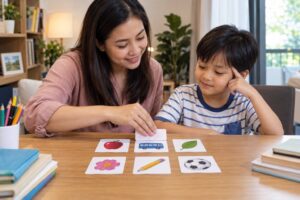
For improve your memory and brain function practice at home, place five picture cards on the table: apple, key, flower, bus, and fish. Let the child look, cover the cards, and rebuild the order. If three are correct, celebrate the three first. Correction lands better after the child feels seen.
2. Ask for meaning before exact words
Before spelling or copying, ask, “What does this mean?” Haris’s composite family let him explain in Malay first, then shaped the English school answer. Many Malaysian children are not lazy; they are carrying meaning across English, Malay, Chinese, Tamil, or dialect before adults judge the final sentence.

3. Use retrieval instead of rereading only
A child can reread a page for twenty minutes and still blank out. Try a two-minute cycle: read a short paragraph, close the book, say two points, then check. The checking step should sound like coaching, not a courtroom. Children repeat routines that feel survivable.
4. Let bilingual explanation become a bridge
The UNESCO multilingual education guidance notes the importance of learning in a language children understand. In a Malaysian home, home language can be the bridge, not the enemy. If the idea is clear in Malay or Mandarin, parents can help the child build the school-language version with less panic.

5. Add a movement reset between rounds
The WHO physical activity fact sheet describes physical activity as important for health and well-being. In a memory routine, movement can be tiny: stand, point to a card, say one fact, and sit again. I use it as an attention reset, not as a medical claim or a replacement for learning support.
6. Stop before tiredness becomes the lesson
The CDC sleep guidance connects sleep with attention and memory in daily life. A child doing revision at 10:30 p.m. may not need one more worksheet. Sometimes the kindest learning choice is one clean recall round, one encouraging sentence, and an earlier finish.
7. Record confidence, not only marks
Write one weekly note: “remembered four cards,” “explained in Malay first,” or “started without arguing.” The Genius Mind Memory Games, Brain Test Report, 90-minute Brain Activation Class, memoHACK Trial Class page, and Genius Mind Academy’s learning approach show how Genius Mind Academy supports memory and learning habits without medical-style promises.
If improve your memory and brain function brought you here, try the five-card routine tonight and stop while the child can still smile. Families who want guided learning support can reach Genius Mind Academy through the contact page.