activities to keep mind sharp was the phrase I wrote in my notebook after a Petaling Jaya mother told me about her Standard 4 son, “Adam.” Adam is a privacy-safe composite drawn from repeated Genius Mind Academy parent conversations: bright in class, cheerful at home, but easily lost when homework had too many steps.
This article was written with the assistance of an AI writing program to help organize information clearly. This image was created using an AI image creation program. For verifiable Genius Mind Academy feedback, families can view the public parent reviews and public student testimonials; this article shares learning routines, not medical advice.

Activities to Keep Mind Sharp: 8 Positive Habits
For Malaysian parents, activities to keep mind sharp should feel small enough for real life. Children may move from SK, SJKC, SJKT, tuition, agama class, Mandarin spelling, English comprehension, and family dinner before anyone opens a revision book. Older siblings may remember UPSR or PT3, while today’s children face PBD, UASA, and eventually SPM pressure.
Genius Mind Academy supports focus, memory, comprehension, confidence, and learning habits. Families can start with GMA memory games, the brain activation class, or the MemoHack trial class. I prefer activities to keep mind sharp that begin with one visible win, because a child who feels successful is more willing to try the next round.
The Harvard Center on the Developing Child executive function guide explains executive function skills such as working memory, attention, and self-control. In parent language, sharp thinking grows when a child notices, holds, retrieves, and explains one thing at a time.
1. Start activities to keep mind sharp with picture cards
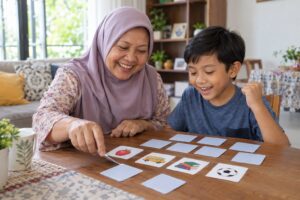
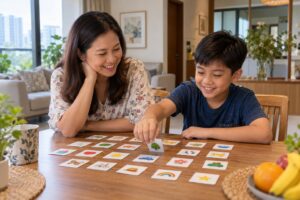
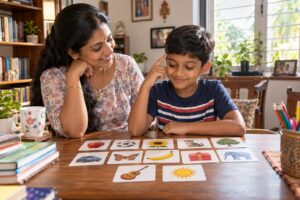
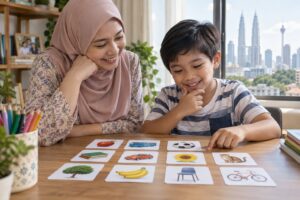
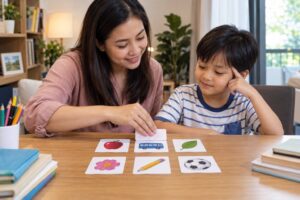
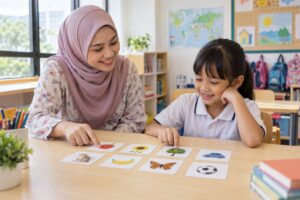
Place six picture cards on the table: apple, bus, tree, sun, cup, and pencil. Let the child look for twenty seconds, cover the cards, and ask for any three. Adam first remembered only bus and sun, so we celebrated those two before checking the missing card.
The spacing and retrieval explainer is useful because it explains why remembering without looking supports learning. Activities to keep mind sharp need a gentle recall moment, not only another round of rereading.

2. Sort details before asking for recall
Ask, “Which cards belong outside?” or “Which ones are things we use at school?” Sorting gives memory a shelf. Children who panic at loose details often relax when the details have a place to sit.
This works for schoolwork too. Before a Science paragraph, ask your child to group examples into animals, plants, objects, and actions. The point is not speed. The point is order.
3. Build a short story route
Choose four cards and let the child create a story: the bus stopped by the tree, the sun shone on the cup, and the pencil wrote a reminder. The story can be silly. It only needs to create a route back to the facts.
When Adam made his own story, he smiled because the answer no longer felt hidden. Activities to keep mind sharp work better when the child helps build the path.

4. Let home language unlock meaning first
Many Malaysian children explain best first in Bahasa Melayu, Mandarin, Tamil, Cantonese, or a warm mix. The UNESCO multilingual education note reminds us that familiar language can support understanding. I listen for meaning first, then help the child shape the school-language answer.
If your child says the idea in mixed language, do not rush to correct every word. Ask, “Can we now turn that into the sentence your teacher expects?” Confidence often returns before grammar becomes tidy.
5. Use a two-minute focus window
Set a timer for two minutes and ask for full effort only inside that window. Short timing lowers resistance because the finish line is visible. Parents also stay calmer because practice does not stretch into the whole evening.
For school nights, activities to keep mind sharp should be short enough to repeat after dinner or before a spelling review. Five calm minutes usually beats twenty tense minutes.
6. Add movement before the second try
Ask the child to stand, touch the door, return, and recall again. The WHO physical activity fact sheet gives broader context for movement and health; in a home routine, even a tiny reset can help attention return.
Children who look tired may need a reset before they need another reminder. Keep movement quick and return to the card or page while the first win is still fresh.

7. Ask how the memory worked
After recall, ask, “How did you remember that?” The child may say, “I saw the apple first,” “I grouped the outside things,” or “I used my story.” Naming the strategy helps the child repeat it tomorrow.
At Genius Mind Academy, this strategy talk matters because confidence is not just praise. Confidence grows when children can describe how they found the answer.
8. Stop before frustration becomes the lesson
The HealthyChildren sleep guide is a helpful reminder that rest supports learning. I would rather see a child finish at 7.30 pm with one clean success than keep pushing until bedtime becomes a battle. Parents can check the KPM academic calendar and plan smaller review blocks before busy school weeks.
If activities to keep mind sharp brought you here, begin with picture cards, sorting, story routes, home-language explain-back, two-minute focus, tiny movement, strategy talk, and a peaceful finish. Malaysian families who want guided child-focused support can reach GMA through the contact page, and the Harvard activity guide offers more age-based activity ideas.