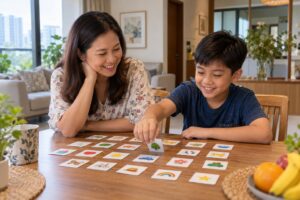
activities to increase brain power is a phrase many parents use when they are worried, but at Genius Mind Academy I translate it into something safer and more useful: help a child focus, remember, understand, explain, and try again. I thought about this after a Shah Alam father described his Year 5 son, “Adam,” a privacy-safe composite of GMA parent conversations, rushing through homework because he wanted to escape feeling slow.
This article was written with the assistance of an AI writing program to help organize information clearly. This image was created using an AI image creation program. For verifiable Genius Mind Academy feedback, families can view the public parent reviews and public student testimonials; this article avoids medical promises.

Activities to Increase Brain Power: 9 Positive Habits
For Malaysian parents, activities to increase brain power should not mean expensive pressure or miracle promises. Children already carry schoolwork, tuition, screen distractions, bilingual learning, PBD tasks, UASA revision, and later SPM expectations. The best routines help the child slow down enough to think clearly.
Genius Mind Academy supports focus, memory, comprehension, confidence, and learning habits. Families can begin with GMA memory games, the brain activation class, and the MemoHack trial class. I like activities to increase brain power that combine attention, memory, comprehension, confidence, and good learning habits in a simple home routine.
The Harvard Center on the Developing Child executive function guide gives a useful framework for executive function. In parent language, brain power grows when a child practises holding information, switching strategies, resisting distraction, and reflecting on what worked.
1. Start activities to increase brain power with a one-minute focus warm-up
Place four picture cards and four coloured blocks on the table. Ask the child to look carefully for one minute and name what is the same or different. Adam first said, “All different,” then noticed two cards were living things. That noticing was the win.
Activities to increase brain power should begin with observation because rushed children often miss details before they even start answering.

2. Build a simple plan before homework
Ask the child to choose the first task, the break point, and the finish signal. A visible plan reduces the feeling of “too much.” It also teaches planning, which is a real thinking skill, not just a productivity trick.
Parents can keep this gentle: BM worksheet first, water break, then Science reading. The child learns that work has order.
3. Use retrieval instead of rereading only
After a short reading, close the book and ask, “What are two things you remember?” The spacing and retrieval explainer explains why pulling information from memory supports learning. This is one of the most useful activities to increase brain power because it makes recall active.
If the child remembers one point, celebrate that point and reopen the book for the missing piece. The tone matters.
4. Let bilingual thinking become a bridge
Many Malaysian children understand a concept in one language before they can write it neatly in another. The UNESCO multilingual education note supports the value of familiar language in learning. Let the child explain in Mandarin, Bahasa Melayu, Tamil, or English first, then convert the answer into the school format.
Adam could explain a Science process in Malay-English mix before writing it in English. That was not failure. That was a bridge.

5. Add a quiet pattern challenge
Use coloured shapes to make a pattern: red, blue, yellow, red, blue. Ask what comes next, then ask the child to create a harder version for you. Pattern play trains attention, prediction, and flexible thinking without feeling like another worksheet.
Activities to increase brain power work best when the child has a turn to design the challenge. Ownership keeps motivation alive.
6. Move once, then return to thinking
The WHO physical activity fact sheet gives the broader health value of movement. In homework time, try a tiny version: stand, stretch, walk to the door, and return to recall one fact. This helps children who fade after school but do not need a long break.
The rule is simple: movement supports thinking; it does not replace the task.
7. Ask for the strategy, not only the answer
Instead of asking only, “What is the answer?” ask, “How did you find it?” The answer may be underlining a keyword, drawing a picture, grouping ideas, or saying it aloud. Strategy talk helps children repeat success.
This is where confidence starts to grow. A child who knows the strategy can try again when a question changes.

8. Protect sleep and review rhythm
The HealthyChildren sleep guide is a useful parent reminder that rest supports learning. A tired brain does not become powerful because we scold it longer. Check the KPM academic calendar, then plan short reviews before busy assessment periods.
For many homes, 7.30 pm is a better learning slot than late night. Keep it short enough to repeat.
9. Close with a confidence sentence
End the routine with one sentence the child can believe: “I can slow down and notice,” “I can remember two points first,” or “I can explain before I write.” The sentence should match what actually happened.
If activities to increase brain power brought you here, start with focus warm-ups, planning, retrieval, bilingual bridges, pattern challenges, small movement, strategy talk, sleep rhythm, and confidence sentences. For guided memory and focus support, Malaysian families can reach Genius Mind Academy through the contact page, and the Harvard activity guide offers more developmentally appropriate activity ideas.