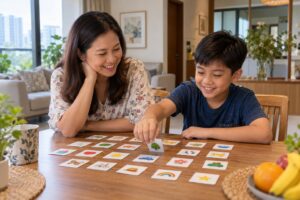
3 ways to improve memory psychology was the phrase I wrote in my notebook on 14 September 2026 after thinking about a Petaling Jaya parent who said her son could recite facts during tuition, then freeze when the teacher changed the question. I will call him Adam, a privacy-safe composite of common Genius Mind Academy conversations: bright, quick to smile, and easily shaken when memory felt like a test he had already failed.
This article was written with the assistance of an AI writing program to help organize information clearly. This image was created using an AI image creation program. Adam is not a private student record; for verifiable GMA feedback, I point families to public parent reviews by Albee Kam, Cindy Sin Yi Paw, Evy Chuah, and jive ty on the memoHACK Trial Class page, plus May Lee, Mr. Chow, and Christina on the parent testimonial videos. I am sharing teaching observations, not a promise of marks or a medical claim.

3 Ways to Improve Memory Psychology: 3 Calm Study Wins
Parents often ask about 3 ways to improve memory psychology because school life in Malaysia is full: Bahasa Melayu spelling, English reading, Mandarin or Tamil homework, agama class, tuition traffic, UASA-style practice, and older siblings talking about SPM. The KPM academic calendar page is a useful reminder that learning runs in seasons, so memory practice should not begin only when assessment week arrives.
Genius Mind Academy’s learning approach supports focus, memory, comprehension, confidence, and learning habits. Families who want guided practice can explore Genius Mind Memory Games, the 90-minute Brain Activation Class, and the memoHACK Trial Class page. At home, I like routines parents can repeat in ten quiet minutes, even on a tired weekday night.
The Harvard Center guide to executive function describes executive function as skills that help children focus attention, manage information, and plan action. That is why 3 ways to improve memory psychology should begin with behavior parents can see, not vague advice such as “try harder.”
1. Lower the pressure before asking children to remember
The first way is emotional safety. With Adam, I would not begin by asking for ten facts. I would place five picture cards on the table, ask him to look carefully, then cover one card. His job is to notice what changed. This keeps the memory task small enough for success.
Parents sometimes think memory starts with sitting still. I see it more practically: eyes on the item, hands settled, one instruction heard, one answer attempted. When those pieces are in place, memory has somewhere to land. If bedtime has been late, the American Academy of Pediatrics sleep guidance is also worth reading because tired children often struggle to pay attention the next day.

2. Use grouping as one of the 3 ways to improve memory psychology
The second way is organization. Children remember more confidently when loose information has a shelf. We group cards into food, transport, object, and action. Then we put them into a simple order. Apple, bus, clock becomes easier when the child says, “food, travel, time.”
This is useful for Malaysian schoolwork because many answers are not random. Science steps, BM isi penting, moral values, and story events all have structure. The AERO spacing and retrieval guide explains why recalling information is different from simply rereading it, and organized recall gives the child a route back to the answer.

3. Practise retrieval with warm explain-back
The third way is retrieval. I ask the child to close the book, say what stayed, and explain one idea back to a parent. If the first explanation comes out in mixed English and Bahasa Melayu, I do not panic. The UNESCO multilingual education guidance notes the importance of learning through languages children understand, so meaning can come before polished school-language sentences.
A small movement reset can help too. The WHO physical activity fact sheet reminds families that movement supports health, and in class a short stretch or walk to the next card can restart attention without turning study time into chaos. The Harvard activities guide for executive function skills also offers age-based ideas for practising executive function skills.
If 3 ways to improve memory psychology brought you here, start tonight with emotional safety, grouping, and retrieval. Use five picture cards, one grouping question, and one explain-back. Stop while your child can still smile. For a guided conversation about your child’s learning habits, contact Genius Mind Academy through the contact page.